•  
Monk views restored 1,300-year-old goddess painting

Monk views restored 1,300-year-old goddess painting

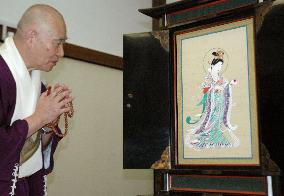
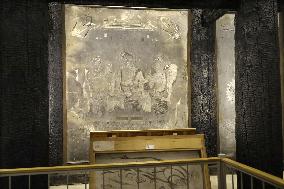
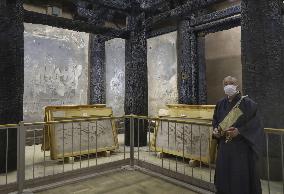
NARA, Japan - A Buddhist monk prays before the re-created painting of "Kichijoten" goddess dating back some 1,300 years at Yakushi-ji temple in Nara, western Japan, on Dec. 8, 2014. The original, a national treasure, was drawn in the eighth century and is currently stored at the temple's treasure house.

  •  
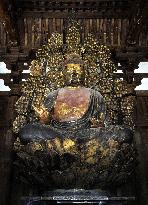
1,300-year-old goddess painting re-created

1,300-year-old goddess painting re-created

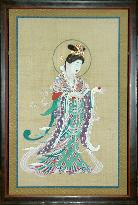
NARA, Japan - The re-created painting of "Kichijoten" goddess dating back some 1,300 years is unveiled to media at Yakushi-ji temple in Nara, western Japan, on Dec. 8, 2014. The original, a national treasure, was drawn in the eighth century and is currently stored at the temple's treasure house.

  •  
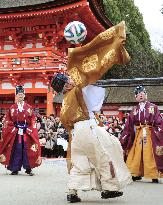
Traditional Kemari event held to pray for Japan's victory in World Cup

Traditional Kemari event held to pray for Japan's victory in World Cup

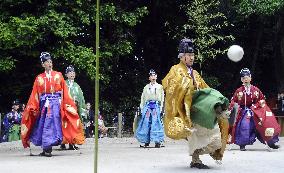
KYOTO, Japan - A man in Heian era (eighth to 12th century) aristocratic attire kicks a ball made of deer skin at a "Kemari" event at Shimogamo Shrine in Kyoto on May 31, 2014. The event was held to pray for Japan's victory in the upcoming World Cup soccer tournament in Brazil.

  •  
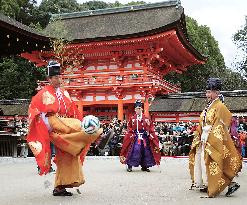
Traditional Kemari event held to pray for Japan's victory in World Cup

Traditional Kemari event held to pray for Japan's victory in World Cup

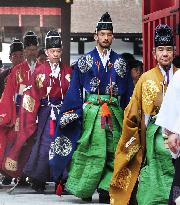
KYOTO, Japan - Hidetoshi Nakata (2nd from R), a former top Japanese soccer player, walks wearing Heian era (eighth to 12th century) aristocratic attire to attend a "Kemari" event at Shimogamo Shrine in Kyoto on May 31, 2014. The event was held to pray for Japan's victory in the upcoming World Cup soccer tournament in Brazil.

  •  
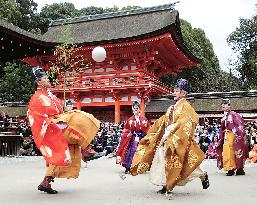
Traditional Kemari event held at Shimogamo Shrine in Kyoto

Traditional Kemari event held at Shimogamo Shrine in Kyoto

KYOTO, Japan - A man in Heian era (eighth to 12th century) aristocratic attire keeps a soccer ball in the air during an traditional annual "Kemari-hajime" event at Shimogamo Shrine in Kyoto on Jan. 4, 2014. The soccer ball was used instead of a traditional ball made of deer skin in tribute to the World Cup soccer tournament in Brazil this year. In Kemari, players continue kicking the mari (ball) in the air to a fixed height as many times as possible.

  •  
Traditional Kemari event held at Shimogamo Shrine in Kyoto

Traditional Kemari event held at Shimogamo Shrine in Kyoto

KYOTO, Japan - People in Heian era (eighth to 12th century) aristocratic attire kick a soccer ball, instead of a traditional ball made of deer skin, in an annual "Kemari-hajime" event at Shimogamo Shrine in Kyoto on Jan. 4, 2014. The soccer ball was used in tribute to the World Cup soccer tournament in Brazil this year. In Kemari, players continue kicking the mari (ball) in the air to a fixed height as many times as possible.

  •  
Traditional Kemari event held at Shimogamo Shrine in Kyoto

Traditional Kemari event held at Shimogamo Shrine in Kyoto

KYOTO, Japan - People in Heian era (eighth to 12th century) aristocratic attire kick a ball made of deer skin in a traditional annual "Kemari-hajime" event at Shimogamo Shrine in Kyoto on Jan. 4, 2014. In Kemari, players continue kicking the mari (ball) in the air to a fixed height as many times as possible.

  •  
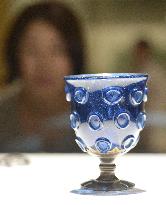
Ancient blue glass cup

Ancient blue glass cup

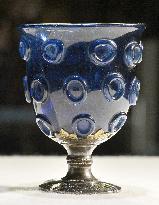
NARA, Japan - Photo shows "Rurinotsuki," an eighth-century blue glass cup, shown to reporters at Nara National Museum in Nara City on Oct. 26, 2012. The item will be shown to the public for the first time in 18 years as part of a special exhibition beginning the following day.

  •  
Ancient blue glass cup

Ancient blue glass cup

NARA, Japan - Photo shows "Rurinotsuki," an eighth-century blue glass cup, shown to reporters at Nara National Museum in Nara City on Oct. 26, 2012. The item will be shown to the public for the first time in 18 years as part of a special exhibition beginning the following day.

  •  
Buddhist treasure repaired

Buddhist treasure repaired

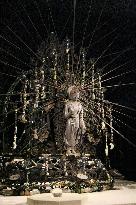
NARA, Japan - The crown for a statue of Fuku Kenjaku Kannon, a form of the bodhisattva Avalokitesvara, is shown to reporters after repairs in Nara, western Japan, on April 2, 2012. The eighth-century crown with a statue of Buddha attached to it will be exhibited from April 3, 2012, at Todai temple museum in Nara.

  •  
Nara's Toshodaiji temple opens Golden Hall

Nara's Toshodaiji temple opens Golden Hall

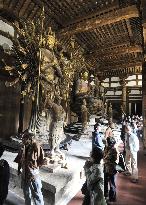
NARA, Japan - Visitors look up at Buddhist statues in the Kondo (Golden Hall) of the temple Toshodaiji in Nara on Nov. 3, 2010, during the first public showing since the hall was presumably built in the eighth century.

  •  
Nara's Toshodaiji temple opens Golden Hall

Nara's Toshodaiji temple opens Golden Hall

NARA, Japan - Visitors look up at Buddhist statues in the Kondo (Golden Hall) of the temple Toshodaiji in Nara on Nov. 3, 2010, during the first public showing since the hall was presumably built in the eighth century.

  •  
Nara's Toshodaiji temple opens Golden Hall

Nara's Toshodaiji temple opens Golden Hall

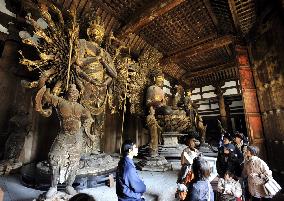
NARA, Japan - Photo shows the Rushanabutsu zazo in the Kondo (Golden Hall) of the Buddhist temple Toshodaiji in Nara on Nov. 3, 2010. The statue was shown to public for the first time since the hall was presumably built in the eighth century.

  •  
1,250th anniv. of Empress Komyo's death

1,250th anniv. of Empress Komyo's death

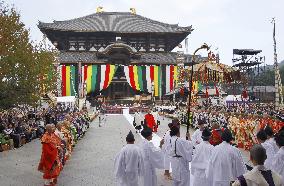
NARA, Japan - A memorial service for the 1,250th anniversary of the death of Empress Komyo is conducted at Todaiji, a Buddhist temple, in Nara on Oct. 15, 2010. The empress was the wife of Emperor Shomu, who took the helm when the western Japan city was the country's capital in the eighth century.

  •  
Japan emperor, empress in Nara

Japan emperor, empress in Nara

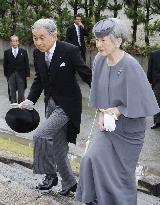
NARA, Japan - Japanese Emperor Akihito (L) and Empress Michiko visit the mausoleum of Emperor Gemmei in Nara on Oct. 9, 2010. Emperor Gemmei was the first emperor of the Nara period in the eighth century when the Japanese capital was located in the western Japan city.

  •  
Karzai in ancient Japanese capital of Nara

Karzai in ancient Japanese capital of Nara

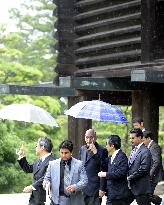
NARA, Japan - Afghan President Hamid Karzai (C) visits the Shosoin Treasure House of the Imperial Household Agency in Nara, western Japan, on June 20, 2010. Karzai visited the eighth-century capital of Japan on the last day of his five-day trip to the country.

  •  
Karzai in ancient Japanese capital of Nara

Karzai in ancient Japanese capital of Nara

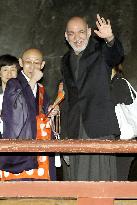
NARA, Japan - Afghan President Hamid Karzai waves in the Daibutsuden Hall of Todaiji Buddhist temple in Nara, western Japan, on June 20, 2010. Karzai visited the eighth-century capital of Japan on the last day of his five-day trip to the country.

  •  
Karzai in ancient Japanese capital of Nara

Karzai in ancient Japanese capital of Nara

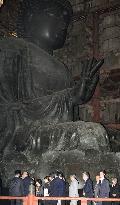
NARA, Japan - Afghan President Hamid Karzai and other members of his delegation visit the Great Buddha statue in the Daibutsuden Hall of Todai temple in Nara, western Japan, on June 20, 2010. Karzai visited the eighth-century capital of Japan on the last day of his five-day trip to the country.

  •  
Karzai in ancient Japanese capital of Nara

Karzai in ancient Japanese capital of Nara

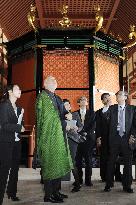
NARA, Japan - Afghan President Hamid Karzai (2nd from L) visits the rebuilt Daigokuden imperial audience hall in Nara, western Japan, on June 20, 2010. Karzai visited the eighth-century capital of Japan on the last day of his five-day trip to the country.

  •  
Pieces of medieval Islamic ceramic vase discovered in Nara

Pieces of medieval Islamic ceramic vase discovered in Nara

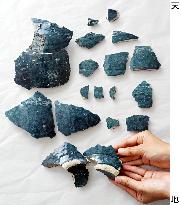
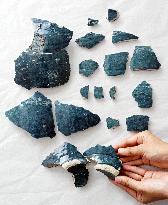
NARA, Japan - Photo shows pieces of a medieval Islamic ceramic vase discovered at Saidaiji Temple in the ancient Japanese capital of Nara. The pieces with a blue-green exterior and dark green interior surface are believed to date back to the late eighth century.

  •  
Anticancer sake festival held at Nara temple

Anticancer sake festival held at Nara temple

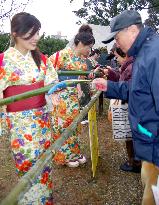
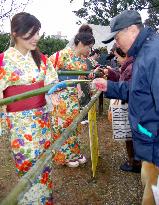
NARA, Japan - Women in kimono, each holding a 1-meter-long bamboo tube, serve hot sake to visitors at a festival to pray for cancer prevention at Daianji Temple in the city of Nara on Jan. 23. Sake is first poured into the bamboo tube and heated with fire before being given to visitors in the ''Sasazake Matsuri'' (bamboo leaf sake festival), which dates back to the eighth century.

  •  
Buddhist caves found west of Afghanistan's Bamiyan

Buddhist caves found west of Afghanistan's Bamiyan

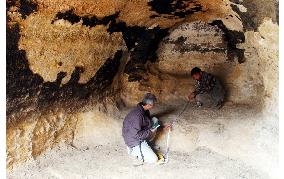
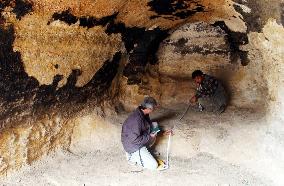
YAKAWLANG, Afghanistan - Takashi Irisawa, professor of Japan's Ryukoku University, checks one of Buddhist caves his team has found in a valley near Yakawlang, some 100 kilometers west of the Bamiyan archeological site on Oct. 14. Bamiyan had been considered to mark the western edge of the spread of Buddhist culture in pre-Islamic Afghanistan, but the discovery of the caves, believed to have been built around the eighth century, suggests there was a large-scale Buddhist cultural area west of Bamiyan.

  •  
Photos of stone chamber of 7th-8th century Takamatsuzuka

Photos of stone chamber of 7th-8th century Takamatsuzuka

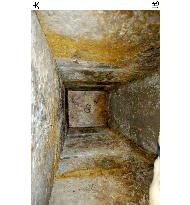
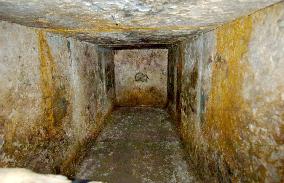
KASHIHARA, Japan - The stone chamber of the seventh- to eighth-century Takamatsuzuka tomb in the village of Asuka, Nara Prefecture, is opened to the press on Sept. 15 for the first time since murals and colorfully painted walls were discovered in 1972. (Pool photo)

  •  
Expo exhibits epitaph of Japanese student in 8th-century China

Expo exhibits epitaph of Japanese student in 8th-century China

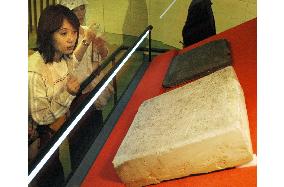
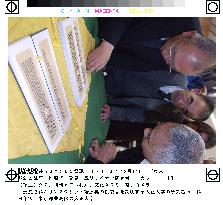
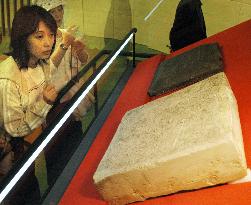
NAGOYA, Japan - Visitors at the Chinese pavilion of the 2005 World Exposition in Nagakute, Aichi Prefecture, view a stone epitaph of a Japanese student who was dispatched to China under the Tang Dynasty in the eighth century.

  •  
(2)Find indicates kana may have originated in Korea

(2)Find indicates kana may have originated in Korea

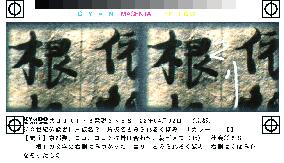
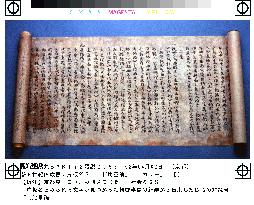
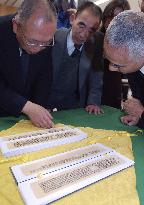
KYOTO, Japan - Photo shows a section of a Korean Buddhist text introduced to Japan in the early eighth century that carries inscribed letters that look like Japanese ''katakana.''

  •  
(1)Find indicates kana may have originated in Korea

(1)Find indicates kana may have originated in Korea

KYOTO, Japan - Photo shows a Korean Buddhist text introduced to Japan in the early eighth century, in which a Japanese scholar has discovered letters that look like Japanese ''katakana.'' The find indicates the kana system could have originated in Korea.

  •  
Sanskrit copy of legendary Buddhist sutra found in Tibet

Sanskrit copy of legendary Buddhist sutra found in Tibet

TOKYO, Japan - A researcher at Taisho University looks at a duplicate of an original Sanskrit text of the scripture called ''Yuima-kyo'' in Japanese and the ''Vimalakirti'' sutra in Sanskrit, at the university in Tokyo's Toshima Ward on Dec. 14. Taisho University researchers discovered the copy, which dates to the eighth century, in July 1999 at the Potala Palace in Lhasa.

  •  
Kitora tomb mural paintings filmed

Kitora tomb mural paintings filmed

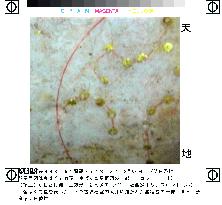
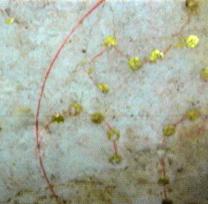
ASUAKA VILLAGE, Japan - Mural paintings inside the chamber of the Kitora tomb in the village of Asuka in Nara Prefecture depict stars in gold foil. The paintings that date back from the late seventh century to early eighth century were filmed with a digital camera through the grave robbers' tunnel and projected on a television monitor Dec. 6.

  •  
Filming of ancient Nara tomb begins

Filming of ancient Nara tomb begins

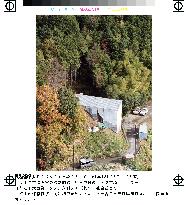
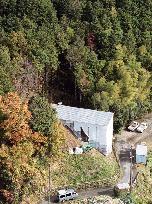
ASUAKA VILLAGE, Japan - An aerial photo shows the Kitora tomb in the village of Asuka, Nara Prefecture, where researchers began filming the inside of the ancient tomb's chamber Dec. 6, 2001. Researchers want to get information for use in restoration work set to begin in 2003 on the tomb's mural paintings that date back from the late seventh century to early eighth century.

  •  
Wall paintings in Golden Hall of Horyuji Temple

Wall paintings in Golden Hall of Horyuji Temple

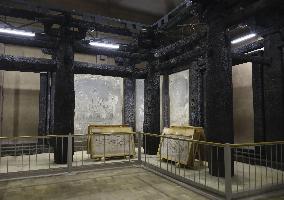
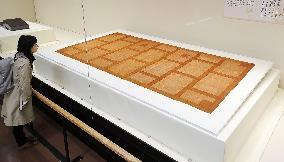
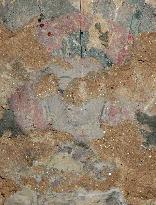
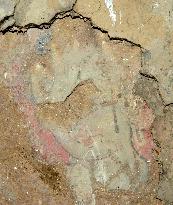
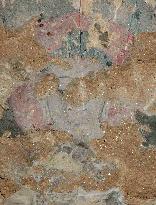
Photo taken on Nov. 1, 2022, shows wall paintings in the Golden Hall of World Heritage-listed Horyuji Temple in the Nara Prefecture town of Ikaruga, western Japan. The murals from around the late seventh century and early eighth century, which were damaged in a 1949 fire in the Golden Hall, were unveiled to the media the same day ahead of their Nov. 2-30 exhibition for people who joined a crowdfunding drive to preserve them.

  •  
Wall paintings in Golden Hall of Horyuji Temple

Wall paintings in Golden Hall of Horyuji Temple

Photo taken on Nov. 1, 2022, shows wall paintings in the Golden Hall of World Heritage-listed Horyuji Temple in the Nara Prefecture town of Ikaruga, western Japan. The murals from around the late seventh century and early eighth century, which were damaged in a 1949 fire in the Golden Hall, were unveiled to the media the same day ahead of their Nov. 2-30 exhibition for people who joined a crowdfunding drive to preserve them.

  •  
Wall paintings in Golden Hall of Horyuji Temple

Wall paintings in Golden Hall of Horyuji Temple

Photo taken on Nov. 1, 2022, shows wall paintings in the Golden Hall of World Heritage-listed Horyuji Temple in the Nara Prefecture town of Ikaruga, western Japan. The murals from around the late seventh century and early eighth century, which were damaged in a 1949 fire in the Golden Hall, were unveiled to the media the same day ahead of their Nov. 2-30 exhibition for people who joined a crowdfunding drive to preserve them.

  •  
Filming of ancient Nara tomb begins

Filming of ancient Nara tomb begins

ASUAKA VILLAGE, Japan - An aerial photo shows the Kitora tomb in the village of Asuka, Nara Prefecture, where researchers began filming the inside of the ancient tomb's chamber Dec. 6, 2001. Researchers want to get information for use in restoration work set to begin in 2003 on the tomb's mural paintings that date back from the late seventh century to early eighth century.

  •  
Kitora tomb mural paintings filmed

Kitora tomb mural paintings filmed

ASUAKA VILLAGE, Japan - Mural paintings inside the chamber of the Kitora tomb in the village of Asuka in Nara Prefecture depict stars in gold foil. The paintings that date back from the late seventh century to early eighth century were filmed with a digital camera through the grave robbers' tunnel and projected on a television monitor Dec. 6.

  •  
Sanskrit copy of legendary Buddhist sutra found in Tibet

Sanskrit copy of legendary Buddhist sutra found in Tibet

TOKYO, Japan - A researcher at Taisho University looks at a duplicate of an original Sanskrit text of the scripture called ''Yuima-kyo'' in Japanese and the ''Vimalakirti'' sutra in Sanskrit, at the university in Tokyo's Toshima Ward on Dec. 14. Taisho University researchers discovered the copy, which dates to the eighth century, in July 1999 at the Potala Palace in Lhasa.

  •  
Ancient dairy product reproduced at 'history food' event

Ancient dairy product reproduced at 'history food' event

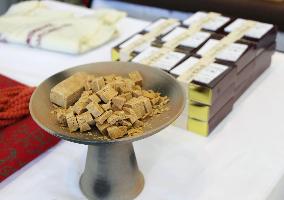
"So," a dairy product made in the eighth-century Nara period, is exhibited in Yamaguchi, western Japan, on Feb. 28, 2015. The event featuring Japan's historical foods was held as a precursor to a "history food summit." (Kyodo) ==Kyodo

  •  
Silk fabric among national treasure house hoard to be displayed

Silk fabric among national treasure house hoard to be displayed

A silk fabric mantle for Buddhist monks is among important cultural artifacts from the Shoso-in Repository in the city of Nara, western Japan, displayed to the press on Oct. 23, 2015, the day before the start of the 67th annual exhibition of items from the national treasure house built in the eighth century. (Kyodo) ==Kyodo

  •  
"Biwa" lute among national treasure house hoard to be displayed

"Biwa" lute among national treasure house hoard to be displayed

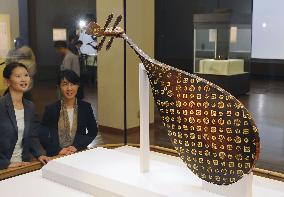
A Japanese "biwa" lute is among important cultural artifacts from the Shoso-in Repository in the city of Nara, western Japan, displayed to the press on Oct. 23, 2015, the day before the start of the 67th annual exhibition of items from the national treasure house built in the eighth century. (Kyodo) ==Kyodo

  •  
Photos of stone chamber of 7th-8th century Takamatsuzuka

Photos of stone chamber of 7th-8th century Takamatsuzuka

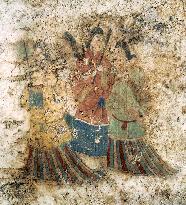
KASHIHARA, Japan - The colorfully painted women on the west wall of the stone chamber of the seventh- to eighth-century Takamatsuzuka tomb in the village of Asuka, Nara Prefecture. The Takamatsuzuka tomb is opened to the press on Sept. 15 for the first time since murals and colorfully painted walls were discovered in 1972. This photo was provided by the National Research Institute for Cultural Properties, Nara. (Kyodo)

  •  
Photos of stone chamber of 7th-8th century Takamatsuzuka

Photos of stone chamber of 7th-8th century Takamatsuzuka

KASHIHARA, Japan - The stone chamber of the seventh- to eighth-century Takamatsuzuka tomb in the village of Asuka, Nara Prefecture, is opened to the press on Sept. 15 for the first time since murals and colorfully painted walls were discovered in 1972. (Pool photo)(Kyodo)

  •  
Pieces of medieval Islamic ceramic vase discovered in Nara

Pieces of medieval Islamic ceramic vase discovered in Nara

NARA, Japan - Photo shows pieces of a medieval Islamic ceramic vase discovered at Saidaiji Temple in the ancient Japanese capital of Nara. The pieces with a blue-green exterior and dark green interior surface are believed to date back to the late eighth century. (Kyodo)

  •  
Japanese team finds colorful mural at Bamiyan ruins

Japanese team finds colorful mural at Bamiyan ruins

TOKYO, Japan - Japanese researchers have found a colorful mural believed to date back to the seventh or eighth century at the Bamiyan ruins in Afghanistan, the National Research Institute for Cultural Properties said July 20. The mural depicts the Buddha and other Buddhist deities. Photo provided by the institute. (Kyodo)

  •  
Japanese team finds colorful mural at Bamiyan ruins

Japanese team finds colorful mural at Bamiyan ruins

TOKYO, Japan - Japanese researchers have found a colorful mural believed to date back to the seventh or eighth century at the Bamiyan ruins in Afghanistan, the National Research Institute for Cultural Properties said July 20. The mural depicts the Buddha and other Buddhist deities. Photo provided by the institute. (Kyodo)

  •  
Japanese team finds colorful mural at Bamiyan ruins

Japanese team finds colorful mural at Bamiyan ruins

TOKYO, Japan - Japanese researchers have found a colorful mural believed to date back to the seventh or eighth century at the Bamiyan ruins in Afghanistan, the National Research Institute for Cultural Properties said July 20. The mural depicts the Buddha and other Buddhist deities. Photo provided by the institute. (Kyodo)

  •  
Expo exhibits epitaph of Japanese student in 8th-century China

Expo exhibits epitaph of Japanese student in 8th-century China

NAGOYA, Japan - Visitors at the Chinese pavilion of the 2005 World Exposition in Nagakute, Aichi Prefecture, view a stone epitaph of a Japanese student who was dispatched to China under the Tang Dynasty in the eighth century. (Kyodo)

  •  
Anticancer sake festival held at Nara temple

Anticancer sake festival held at Nara temple

NARA, Japan - Women in kimono, each holding a 1-meter-long bamboo tube, serve hot sake to visitors at a festival to pray for cancer prevention at Daianji Temple in the city of Nara on Jan. 23. Sake is first poured into the bamboo tube and heated with fire before being given to visitors in the ''Sasazake Matsuri'' (bamboo leaf sake festival), which dates back to the eighth century. (Kyodo)

  •  
Japanese univ. team finds stone caves 120 km west of Bamiyan rui

Japanese univ. team finds stone caves 120 km west of Bamiyan rui

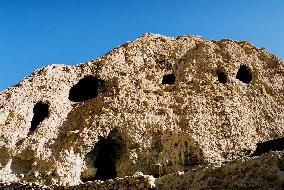
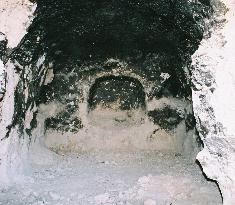
TOKYO, Japan - Photo shows one of Buddhist stone caves found by a Japanese research team in late October on cliffs located 1 km west of Keligan ruins and 120 km west of the Bamiyan ruins in central Afghanistan. The caves are believed to date back to the eighth century, said members of the team, headed by Ryukoku University professor Takashi Irisawa, on Nov. 9. The photo was provided by Akira Inoue. (Kyodo)

  •  
Japanese univ. team finds stone caves 120 km west of Bamiyan rui

Japanese univ. team finds stone caves 120 km west of Bamiyan rui

TOKYO, Japan - Photo shows one of Buddhist stone caves found by a Japanese research team in late October on cliffs located 1 km west of Keligan ruins and 120 km west of the Bamiyan ruins in central Afghanistan. The caves are believed to date back to the eighth century, said members of the team, headed by Ryukoku University professor Takashi Irisawa, on Nov. 9. The photo was provided by Akira Inoue. (Kyodo)

  •  
Buddhist caves found west of Afghanistan's Bamiyan

Buddhist caves found west of Afghanistan's Bamiyan

YAKAWLANG, Afghanistan - Takashi Irisawa, professor of Japan's Ryukoku University, checks one of Buddhist caves his team has found in a valley near Yakawlang, some 100 kilometers west of the Bamiyan archeological site on Oct. 14. Bamiyan had been considered to mark the western edge of the spread of Buddhist culture in pre-Islamic Afghanistan, but the discovery of the caves, believed to have been built around the eighth century, suggests there was a large-scale Buddhist cultural area west of Bamiyan. (Kyodo)

  •  
1,250th anniv. of Empress Komyo's death

1,250th anniv. of Empress Komyo's death

NARA, Japan - A memorial service for the 1,250th anniversary of the death of Empress Komyo is conducted at Todaiji, a Buddhist temple, in Nara on Oct. 15, 2010. The empress was the wife of Emperor Shomu, who took the helm when the western Japan city was the country's capital in the eighth century. (Kyodo)

  • Main
  • Top
  • Editorial
  • Creative
  • About Us
  • About ILG
  • Terms of use
  • Company
  • BEHIND
  • Price List
  • Single Plan
  • Monthly Plan
  • Services
  • Shooting
  • Rights Clearance
  • Support
  • FAQ
  • How To Buy
  • Contact Us
  • Become a Partner

© KYODO NEWS IMAGES INC

All Rights Reserved.

  • Editorial
  • Olympics
  • News
  • Sports
  • Japan
  • Tech
  • Royal
  • Disaster
  • NorthKorea
  • Old Japan
  • SNS
  • Creative
  • Food
  • Japan
  • Landscape
  • Animal
  • Popular
  • #Ukraine
  • #Russia
  • #coronavirus
  • #N. Korea
  • #China
  • #Thailand
  • #Ukraine
  • #Russia
  • #coronavirus
  • #N. Korea
  • #China
  • #Thailand
  • Food
  • Japan
  • Landscape
  • Animal
  • Olympics
  • News
  • Sports
  • Japan
  • Tech
  • Royal
  • Disaster
  • NorthKorea
  • Old Japan
  • SNS